


Freddy Potoy Rosales
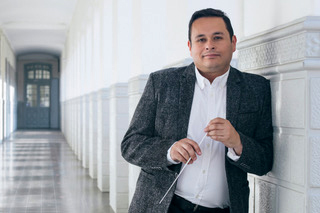
Camilo Jauregui is a music scholar whose career has embodied a constant commitment to reconstructing social, cultural, and artistic connections in post-conflict contexts. His vocation has led him to work in countries that have needed to heal their deep wounds through art, from his native Colombia in South America to Afghanistan in Central Asia.
For Jauregui, the relationship between Music and society is undeniable:
“In our Latin American countries, the lack of governability has had consequences that impact culture. In Colombia, when I was a child and part of the social rebuilding process in the country, it was Music that helped me understand that it is an essential tool for rebuilding nations,” he affirms.

Concierto de la academia de invierno en Kabul – Afghanistan Feb de 2016 en la Radio y Television “TOLO” / Winter Academy Concert in Kabul, Afghanistan, February 2016, on TOLO Radio and Television
His academic training supports this conviction: he holds a master’s degree in Musicology from the University of La Rioja in Spain and another in Music from the Juan N. Corpas University in Bogotá.
In his international career, Jáuregui has had the opportunity to work within complex scenarios. He lived in Afghanistan for almost three years, collaborating with the National Institute of Music, where he directed the youth orchestra, taught percussion, and shared elements of Latin America’s musical heritage. While there, he witnessed historic moments, such as the creation of the Muslim Women’s Orchestra, a significant achievement in a country with strong social restrictions.
“It was a joint effort on the part of many professors and colleagues. Seeing young people graduate from the percussion program and confirming that today they are professional musicians is enormously satisfying,” he recalls.

Clases individuales salon de percusión (ANIM) Afghan National Institute of Music – Kabul 2014 / Individual lessons in the percussion room (ANIM) at the Afghan National Institute of Music – Kabul 2014
His work also took him to Sri Lanka, where he participated in The Music Project, an initiative that uses orchestras as a means of teaching and community cohesion. In addition, he has collaborated in Colombia with projects such as Batuta and with the renowned Venezuelan program Tocar y Lucha, convinced that the method of “orchestra systems helps to rebuild countries.”
For eight years now, Pittsburgh has become his home and the setting for a new stage in his career. While here, he has worked with groups such as the West Hills Symphonic Band, Resonance Works, and various local orchestras. Recently, he performed as a soloist with the Pittsburgh Civic Orchestra, performing a concerto for vibraphone by Mexican composer Patricia Moya, something that allowed him, as he himself points out, “to promote Latin American Music in the city.”
Currently, Jauregui is co-director of Camerata 33 in Pittsburgh and teaches at prestigious educational institutions, including South Fayette High School, Carnegie Mellon University, the University of Pittsburgh, and Waynesburg University.

Camilo Jauregui – Camerata 33
His path has not been without challenges, but Music has always been his refuge and driving force:
“No matter how complicated moments in life are, one must always hold on to what one deeply believes. In my case, Music has rescued me and helped me understand many things,” he says.
With each project, Camilo Jauregui reaffirms his view that Music is an art and, at the same time, a powerful tool with which to heal, transform, and build hope in the midst of adversity.
This story is featured in Pittsburgh Latino Magazine’s September-October 2025 issue.
Translation by Kenya C. Dworkin y Méndez

Bogota, Colombia 2022 (Foto/Photo: Paola Enciso)
Connect with Camilo Jauregui:
Facebook.com/camilo.jauregui.5
Instagram.com/412jauregui
Facebook.com/Camerata33


