


Agencia EFE
By Carla Samon Ros
Necoclí, Colombia, Sep 10 (EFE).- Thousands of Latin American migrants, mainly Venezuelans, are retracting their steps southward after deportations and stricter United States immigration policies under United States President Donald Trump. At least 14,000 have returned since January, according to the United Nations, with about half planning to resettle in Venezuela.
Elio Mora, a 45-year-old Venezuelan who asked to use a pseudonym, recalled his detention after a hearing in Atlanta, where a judge had just renewed his residency permit.
“As soon as I left the courtroom, ICE handcuffed me,” he told EFE.
He spent five weeks in detention before being deported to Mexico in August.

Photograph of Venezuelan migrant children being cared for by ICBF workers upon their arrival from Capurganá to Necoclí (Colombia). Aug. 29, 2025. EFE/ Juan Diego López
From there, he began the reverse journey through six countries back toward Venezuela.
“The American dream is over,” said Mora, eating rice and chicken in an improvised dining hall run by a pastor in Necoclí, a Caribbean port city where he and thousands once began the northbound trek across the Darién Gap.
Since Trump returned to power in January, his administration has launched a new anti-immigration drive.
Migrants say deportations have accelerated, forcing many to reconsider their futures.
Changing face of Necoclí
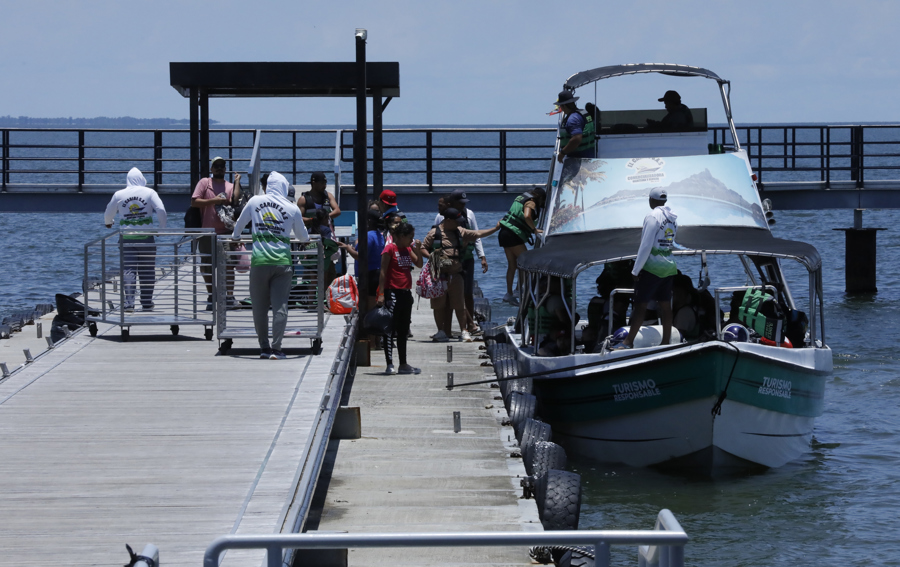
More arrived in Necoclí in August after 13 days of travel. Boats from Panama docked with both tourists and migrants, a reminder of the town’s dual identity: a beach destination and a migration hub.
He and four Venezuelan companions, some deported and others who decided to return voluntarily, bought bus tickets to Medellín and planned to continue on to the Venezuelan border.
The Necoclí they saw was very different from 2023, when more than 500,000 migrants passed through, overwhelming the town of 25,000.
At the peak, 20,000 migrants camped on its beaches. Now, beaches are filled with umbrellas and banana boats instead of tents.
Mayor Guillermo José Cardona said the so-called “reverse migration” is overstated. “They may be arriving, but they leave right away,” he told EFE.
Official data shows at least 12,150 migrants traveling south through Necoclí between January and June.

Photograph of Venezuelan migrants eating at a community dining hall in Necoclí (Colombia). Aug. 29, 2025. EFE/ Juan Diego López
Humanitarian support fading
At a Pentecostal church near the port, Pastor José Luis Ballesta runs a soup kitchen serving 200 meals daily.
Many migrants are deportees or those who ran out of money on the northward route and are now returning home.
One Venezuelan woman, who tried to reach Panama but turned back after her resources ran out, now survives by selling candy and eating at the church.
But a sign warns that after six years, the kitchen will close for lack of funds.
“The sadness is that migration has not ended,” Ballesta said, citing reduced humanitarian aid and cuts in U.S. funding.
From now on, the church will only provide small snacks to new arrivals unless donors intervene.

Photograph of Venezuelan migrants arriving from Capurganá to Necoclí (Colombia). Aug. 29, 2025. EFE/ Juan Diego López
Families divided
For Mora, the hardest part of the journey is being apart from his wife and two sons.
His younger child, who stayed in Venezuela with his mother, recently turned 12. “Being alone is hard. I cried almost every day because I missed my family,” he said.
Before his deportation, Mora worked assembling doors in Atlanta, earning enough to send money home. His eldest son remains in the US in hopes of securing asylum for the family.
“You can earn well in the US, but being without your loved ones is stronger than any salary,” Mora said, showing the last WhatsApp message he sent his wife: “Soon we’ll be together again, my princess.”
EFE
csr/seo


