

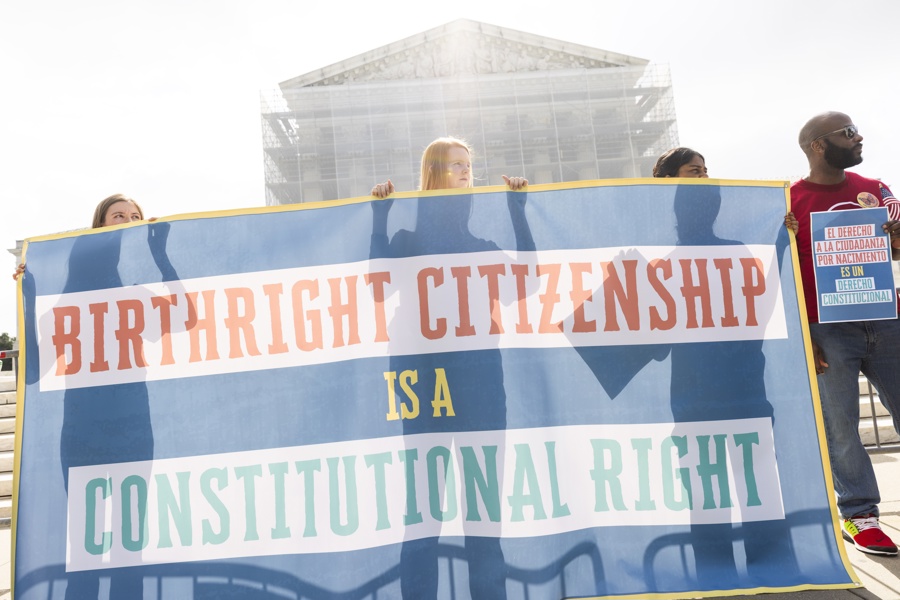
New York City, July 10 (EFE).- A US federal judge on Thursday issued a nationwide block on President Donald Trump’s executive order seeking to end birthright citizenship, which he announced on his second day in office and has proven to be one of the most controversial.
“The deprivation of US citizenship and an abrupt change of policy that was longstanding … that’s irreparable harm,” said Judge Joseph Laplante, of the US District Court for the District of New Hampshire, in the ruling.
He issued a seven-day pause in his decision to allow for appeal, according to the case filed as a class action by the American Civil Liberties Union (ACLU).
The judge, who was appointed by former president George W. Bush, emphasized that US citizenship “is the greatest privilege that exists in the world.”
The executive order was scheduled to take effect on July 27, after the Supreme Court invalidated similar blocking orders issued by state judges on the grounds that they could not bar executive orders with federal reach. This was considered a ruling of enormous legal significance given the “wall” of judicial decisions that have opposed Trump’s policies.
Laplante’s ruling states that the plaintiffs may suffer irreparable harm if the blocking order was not granted.
“This ruling is a huge victory and will help protect the citizenship of all children born in the United States, as the Constitution intended,” said Cody Wofsy, deputy director of the ACLU’s Immigrants’ Rights Project, who argued the case. “We are fighting to ensure President Trump doesn’t trample on the citizenship rights of one single child.”
Trump’s “border czar” Tom Homan said this was “another example of a radical judge not paying attention to the Supreme Court ruling.”
“They want to stop the Trump agenda. And what they need to understand: The American people voted for this agenda,” he told reporters at the White House.
The judge’s ruling referred to “all current and future children” who would be affected by the executive order, but did not include their parents as the plaintiffs had requested.
Laplante already challenged the same executive order in another February ruling, but limited its scope to members of several non-profit groups that would have been affected.
He argued that Trump’s order contradicted the 14th Amendment of the Constitution, which holds that “all persons born or naturalized in the United States, and subject to the jurisdiction thereof, are citizens of the United States and of the state wherein they reside.”
Several other judges also ruled that Trump’s order was unconstitutional, but applied nationwide.
Courts have consistently rejected the idea in Trump’s order that children born to undocumented immigrants should not be covered by the 14th Amendment
The lead petitioner, “Barbara” (last name withheld), is a Honduran citizen pending an asylum application and expecting her first child in October of this year, to be born on US soil.

(FILE) US President Donald J. Trump responds to a question from the news media during a press conference in the briefing room of the White House in Washington, DC, USA, 27 June 2025. EFE/EPA/SHAWN THEW
The lawsuit notes that birthright citizenship is a treasure guaranteed by the 14th Amendment and by extensive case law. EFE


