

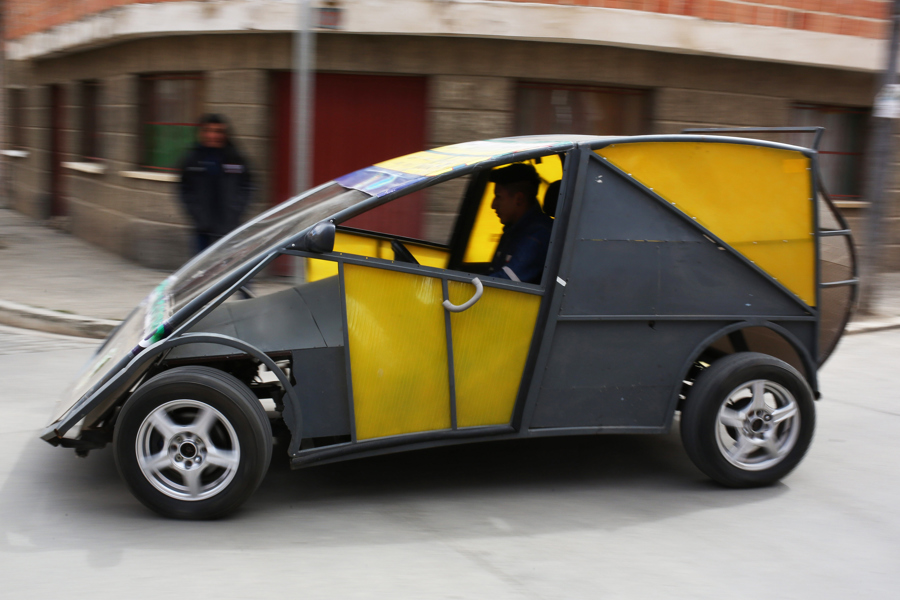
El Alto, Bolivia, Jul 13 (EFE). – Engineering students and professors at a public university in Bolivia have built the Katari MRC5, an electric vehicle powered by a lithium battery manufactured domestically. The initiative aims to create a long-term alternative to fossil fuel-based transportation in the South American nation.
The Katari MRC5 is the fifth prototype in a series developed by the Electrical Engineering Department of the Public University of El Alto (UPEA).
Earlier versions ran on lead-acid batteries and solar panels, but this is the first to use a lithium battery produced by Bolivia’s state-owned company Yacimientos de Litio Bolivianos (YLB).
“This is the first prototype powered by a Bolivian-made battery, developed in collaboration with YLB,” project coordinator and professor Elías Choque told EFE.
Local battery, national potential
YLB provided two lithium battery units for the project. UPEA’s role is to conduct performance testing including full charge and discharge cycles, Choque explained.
While technical specifications remain confidential, the battery offers up to 12 hours of autonomy, depending on driving conditions such as steep inclines and acceleration patterns.

Students check the electric car Katari MRC5 in El Alto, Bolivia, Jul. 3, 2025. EFE/ Luis Gandarillas
One of the team’s goals is to test the vehicle on a long-distance journey between La Paz and the Andean region of Oruro, approximately 140.3 miles, to better assess its real-world capabilities, according to technician Walter Canaza.
“This kind of testing will give us our first solid conclusions,” he said.
Weighing just 771 pounds, the Katari MRC5 was built using recycled materials and components from disused cars.
It accommodates two passengers and features a lightweight, hand-welded frame, custom shock absorbers, and an adapted steering system.
The project took two years from concept to completion, involving aerodynamic studies, design refinements, and aesthetic adjustments.
Canaza praised the students and faculty for their perseverance, especially given the limited access to specialized automotive software.
Students drive innovation
“This project shows that when creativity meets determination, we can overcome structural limitations,” said one student involved, noting that Bolivia lacks an established automotive industry.
One standout participant is María Luz Luque, one of several women entering the male-dominated field of electrical engineering at UPEA.
She highlighted how the project allows students to apply their knowledge in a practical and forward-looking way.
“With more electric cars expected to be on the roads soon, it’s essential we learn how these systems work firsthand,” she told EFE.
Bolivia has faced persistent fuel shortages since 2023, sparking debate within universities about potential alternatives.
Students and faculty at UPEA see electric mobility as a promising path forward, though many challenges remain.
“Projects like this will keep evolving,” Choque said. “We need to discuss how to meet future electric demand, address cybersecurity, and create the right conditions to support this kind of innovation.”
Lithium: Bolivia’s strategic resource
Bolivia holds one of the world’s largest lithium reserves, estimated at 23 million tons, making the resource a strategic priority for the national government.
The Uyuni salt flat in the Andean department of Potosí, situated at 11,811 above sea level, hosts the country’s main lithium deposit.
YLB operates a lithium carbonate production plant in Uyuni, a site that also ranks among Bolivia’s top tourist destinations.
The success of projects like the Katari MRC5 could one day link Bolivia’s natural resources with local technological innovation, helping the country transition toward a more sustainable future.
Text: By Gabriel Romano Burgoa / EFE


