

Patrick Fisher
When you look at the hands of José del Carmen González Santana, you see evidence of a lifetime of physical labor. For nearly five decades, the Panamanian artisan’s hands have been conditioned by the repetition of the same meticulous tasks. But it wasn’t construction, farming, or fishing that shaped them. It was molding clay into busts of animals such as lizards, chickens, and jaguars, and even more notably, dragon-like devils.
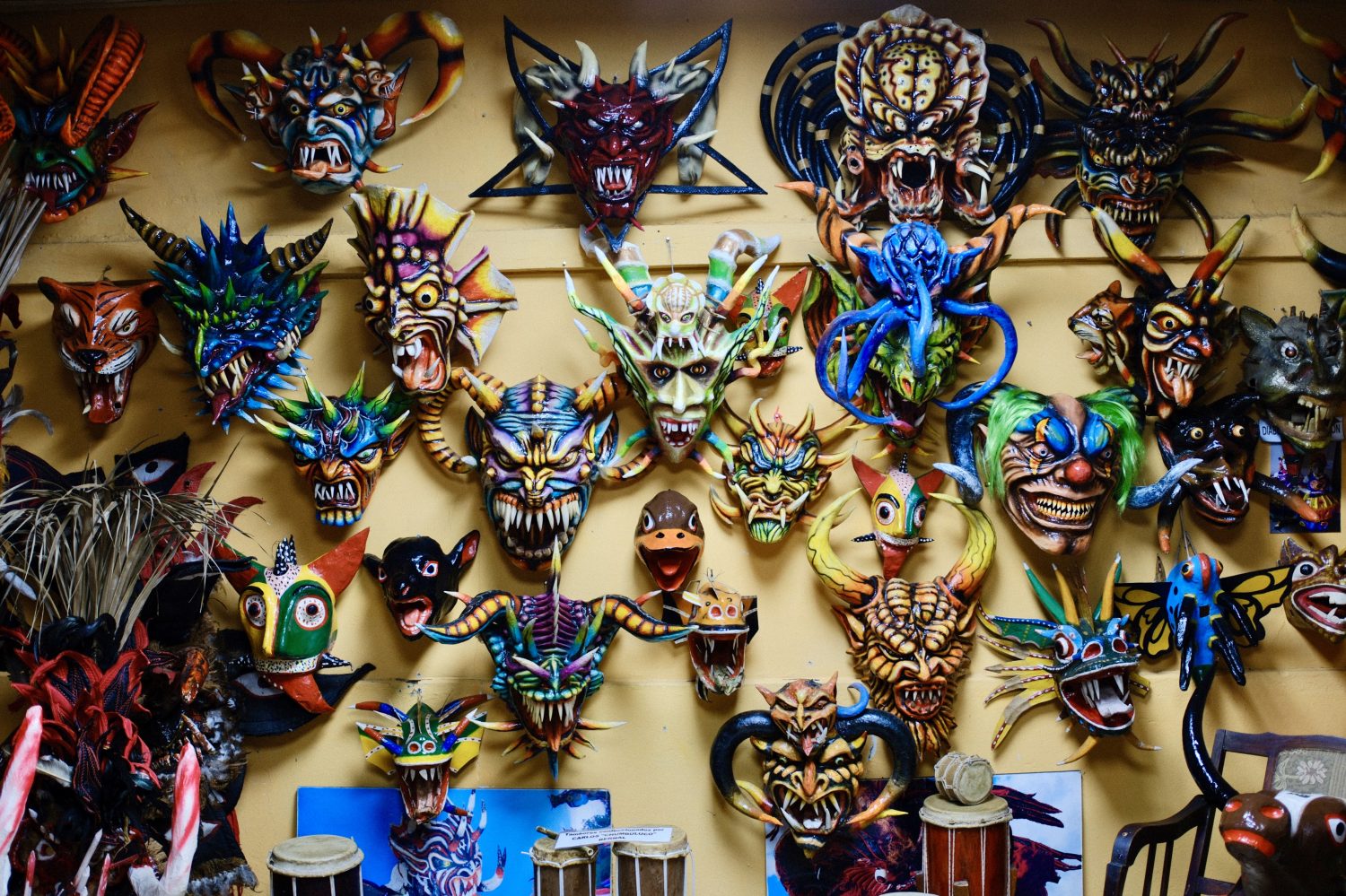
Once dried, these clay busts become molds. José then builds layers of papier-mâché over them, creating the foundation for masks that are central to a country-wide folk art and cultural tradition. These masks are worn by Panama’s diablos, or “devils,” and José, along with his wife, Angela, and the apprentices he has trained, is part of an ecosystem of artisans throughout the country who serve as culture bearers and play an important role in the tradition of Danza de Diablos, or “The Dance of the Devils.”
In my current role as CEO at the Greater Pittsburgh Arts Council, I document Pittsburgh-based artists, and throughout my adult life I’ve used travel as an opportunity to more deeply understand cultural traditions that are rooted in places and people. In Chitré, about three and a half hours outside Panama City, I was invited to witness delegations of diablos from across the country coming together and performing in the same procession for the first time ever.
My invitation to Panama came from documentary filmmaker and photographer Luis Carlos García. Originally from Chitré, Luis moved to Erie, Pennsylvania, around 2021 because his wife, Monica, is from Erie County. When we met, I was leading Erie Arts & Culture and Luis was in the final stages of an eight-year project, Danza con Diablos, a feature-length documentary he co-created with screenwriter Jan Valdés and Producer José Antonio Tuñón. The film showcases the artisans who keep the diablo tradition alive while highlighting the striking regional differences among Panama’s practitioners.
Before meeting Luis, I knew nothing about the tradition, but I was instantly captivated by the striking photographs he had taken of the diablos over the years. Some of these photos can be viewed in Pittsburgh this fall in the Latin American Cultural Center‘s exhibit, Crossroads of the World: Panama, which opens to the public on September 22.
When Luis was younger, he says diablos would visit his primary school as part of La Búsqueda y Traída de San Juan, the celebration of Chitré’s patron saint. But rather than feeling a sense of cultural pride during those visits, Luis felt fear.
“I remember going to school and being terrified of the diablos who would visit,” he shares. “I was so afraid of them that I didn’t even want to leave my house.”
His deeper interest in the tradition didn’t emerge until later in life. During a return trip to Panama in 2016, he attended the annual Corpus Christi festival, where the diablos play a central role, making him realize how little he actually knew about his own culture. It was this experience that would kickstart what would eventually become Danza con Diablos, leading him to learn everything he could by working with anthropologists, historians, musicians, artisans, and families who have maintained these traditions for centuries.
Luis’ project didn’t just spark my curiosity; it also helped renew national interest in this uniquely Panamanian folk tradition. As that interest grew, Luis and his collaborators began to wonder whether the time had come to create a new tradition: a national festival bringing together delegations of diablos from across Panama.
“It is important for new generations to know these traditions so they don’t lose their connection to their roots,” Luis says. “Younger generations are the ones who will make sure these traditions live on.”
The walls of Rafael’s grassroots museum are adorned with over 90 masks, the oldest dating back to the 1940s. Traditional pieces are exhibited alongside contemporary ones, letting visitors trace how masks and attires have evolved over the years. Every mask carries a story, and Rafael knows not only which region and era each mask comes from, but the artisans whose hands made them and the diablos who wore them.
I arrived in Panama two days before the national parade, which allowed Luis to introduce me to some of the festival’s artisans. On my first evening in the country, Luis took me to visit Rafael Medina and his Casa de Folklore museum, which were featured in his documentary.
It wasn’t until after his conversations with Luis while shooting the documentary that Rafael realized he could play a greater role in preserving and sharing the history of Panama’s folk practices and traditional arts, so he started the independent museum.
Two days later, during the opening ceremony of the festival, I met Carlos Manuel Rosas, a 25-year-old who is part of Diablicos Limpios of Chitré, a local delegation of “clean devils” that had been dormant since the 1980s despite an attempt to revive the group in 2015. Carlos formally began dancing as a diablo only this year, remembering the date as “a wonderful day because I knew it was the beginning of a legacy.”
Diablicos Limpios of Chitré were the only delegation to perform on the opening night of the festival. In the national parade, Carlos was performing as the Diabla, a witch-like character, who’s a more esteemed — though jocular — position within the hierarchy of many participating characters.
The story they tell through their performance is one of two forces confronting one another in an epic struggle between good and evil, eventually ending in the defeat of the Devil. Only then does the tone change. The solemnity gives way to humor as the Diabla is introduced, a role less about advancing the religious story than bringing a playful, human dimension to the performance.
She is a reminder that the Diablicos Limpios are not simply reenacting a morality tale; they are also practicing a form of popular theater that has evolved within the community over generations.
That evening, I realized I witnessed the Diablicos Limpios of Chitré not simply performing a dance, but reclaiming a tradition. When asked what it felt like to be the first delegation to perform as part of the national parade, Carlos shared, “It was a wonderful feeling because we lived the tradition for the first time in so many years, and the people of Chitré applauded something important that was reintroduced to the community.”
It’s easy to watch a cultural event and see only what’s in front of you. Following the delegations through the streets of Chitré that afternoon, sweating in the Panamanian sun, I kept catching myself doing the opposite: thinking about the organizers who envisioned a gathering of this scale, the sponsors who invested in that vision, the delegations who’d traveled upward of nine hours to be a part of something grand, and the mask makers, tailors, and other unseen hands without whom none of it could exist.
A gathering this size gave Panama a rare, unprecedented chance to celebrate the diablo tradition together, in public, all at once, and I was lucky enough to be let into it, welcomed by people who shared their history with a visitor who arrived knowing almost nothing. I don’t take that lightly. When the Latin American Cultural Center opens Crossroads of the World: Panama this September, I hope it gives Pittsburgh a small window into what I witnessed in Chitré: not just a performance, but the living history behind it.


