

| In an effort to better share the experiences of the Pittsburgh area’s Spanish-speaking community, PublicSource is partnering with Pittsburgh Latino Magazine and journalist Freddy Potoy Rosales from Nicaragua to bring Spanish-first reporting to readers in both Spanish and English. Read this story in Spanish here. |
By Freddy Potoy Rosales
Pastor Nilsson Devia arrived in the United States from Colombia 10 years ago with his family, applied for asylum and has yet to have his case resolved. Now, the leader of the pentecostal congregation is lamenting the persecution he says the Latino community is experiencing amid a broad immigration crackdown.
“We lived through the first Trump administration and we are living through this second one. We see the aggressiveness with which the immigration issue is being handled and the impact it has had on the Latino community specifically; our church members have felt frightened,” said the 46-year-old pastor.
Devia recalled that “in the first weeks of (President Donald Trump’s new) administration you could see a decrease in congregational attendance above 40%.” Several church members have opted to use social networks due to the fear of leaving their homes, he said, but others frequent the temple three times a week because they consider it a safe place.

Pastor Nilsson Devia lays hands on parishioners as they pray during an alter call at pentecostal mass on Sunday, March 2, 2025, at Sharon Community Presbyterian Church in Moon Township. The Pentecostal church has its services in Spanish at the location on Sunday afternoons. (Photo by Stephanie Strasburg/PublicSource)
The congregation also provides emotional and spiritual support and has shared with its church members a packet of legal instructions on what to do if they are approached by authorities. In addition, it helps Latino migrants find jobs and a safe place to live.
Churches of different denominations in the Pittsburgh area are providing various services and support to Latino immigrants facing uncertainty and fear in the face of the new immigration policies imposed by Trump.
After Trump took office on Jan. 20, in his second non-consecutive term, he has implemented a more aggressive immigration policy than in his first administration, particularly against the Latino community, according to religious leaders consulted by PublicSource. Trump’s shifts have included declaring a national emergency at the border, expanding deportations, aiming to restrict birthright citizenship, proposing new travel bans and invoking the Alien Enemies Act to expedite removals.
Here’s what local churches are seeing, and how they’re responding.

A flyer from American Immigration Lawyers Association with information on immigrant rights in case of an ICE visit, pasted on a street pole on Broadway Avenue in Beechview on Feb. 14. (Photo by Amaya Lobato Rivas/PublicSource)
In Beechview: Anonymous intimidating messages
At Saint Teresa of Kolkata Parish in Beechview, in Pittsburgh’s South Hills, Rev. Fernando Torres Aguirre said that “the Catholic Church in general tries to defend the rights of all people.”
Torres, 51 and of Mexican origin, knows the difficulties that immigrants have with the new regulations. “There are many people who do not have all their (official immigration) papers, so the church has always been assisting these people,” the priest added.
In addition to spiritual guidance and informing immigrants of their rights, the parish also provides food, clothing and financial assistance to those who are behind in paying their rent.

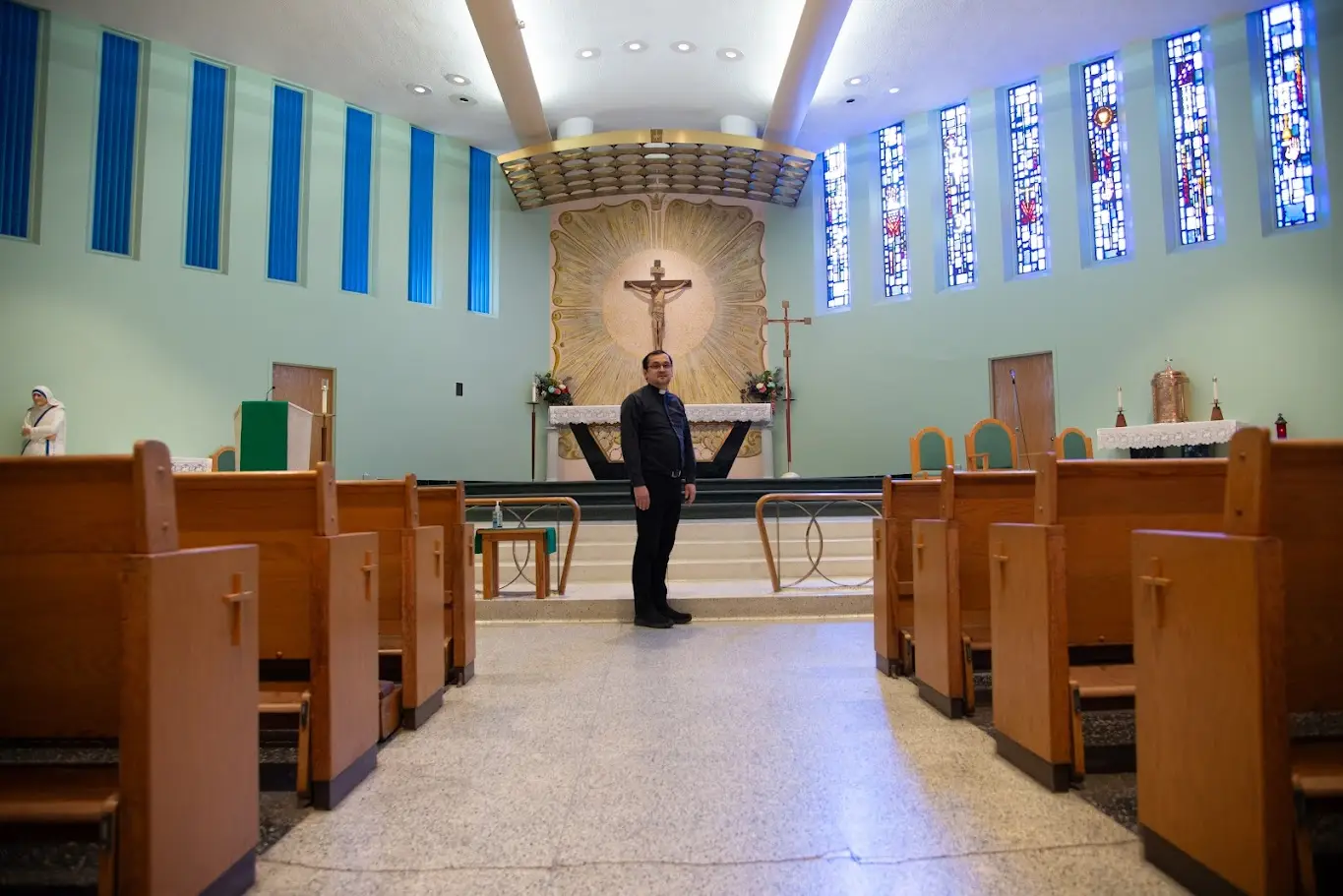
Rev. Fernando Torres Aguirre near the altar at St. Catherine of Siena Church in Beechview on Feb. 14, 2025. Although attendance at the church has declined somewhat due to fear, Torres said that “so far,” worship there “has been very safe…” (Amaya Lobato Rivas/PublicSource)
He works closely with Casa San José, a nonprofit organization that serves as a base of support for the Latino community, providing a variety of resources, such as weekly clinics, food pantries, community meetings, learn-your-rights sessions and much more.
“On the practical side, Casa San José helps us a lot; every time someone needs anything legal, we send them there,” he said. “Or, sometimes after mass we ask Casa San José to come here (to the church) and explain (to the immigrants) what to do in case they are detained by Immigration” and Customs Enforcement [ICE].
With new immigration policies have come reports of anonymous intimidating messages to the Latino community, distributed in Beechview. The notes read: “All illegal aliens, please leave Beechview! We have contacted ‘ICE’ Border Patrol.”
PublicSource emailed Cara Cruz, spokesperson for Pittsburgh’s Department of Public Safety, who said the messages threatening the Latino community left at various locations, including Las Palmas Supermarket, Casa San José and Saint Teresa of Kolkata, are being investigated by plainclothes detectives.
“I will tell you that the handwritten notes that were turned over to police, while extremely disturbing to the recipients, are not criminal in nature,” wrote Cruz, who added that “police are reviewing all the videos to try to identify a suspect and will continue with the investigation to the extent available given the nature of the incident.”
“Now,” Torres said, “the owners of the stores that are here (in Beechview) see that fewer Hispanics are coming, who are the ones who consume the most in this area; this hurts the economy and the unity among all.”
Although attendance at Saint Teresa of Kolkata has declined somewhat due to fear, Torres said that “so far,” worship there “has been very safe and we have laid the groundwork to make it quite secure. People come, (but) you can feel the nervousness, you can see that there are fewer people.”
“We have our catechesis group for children, most of them are still coming, for now, but there is a small group that we are assisting through Zoom so that parents who feel a little nervous about coming here do not stop nurturing their children in the faith,” the priest said, adding that the church continues to offer Spanish religious services to the Latino community.
In Knoxville: Faith and increasing attendance
Legacy Church — León de Judá, a Christian church in Knoxville, is another denomination focused not only on helping meet basic needs such as clothing and food, but also providing spiritual support and immigration guidance.

Sandra Diaz and Anahí Jiménez stand in front of the entrance to Legacy Church in Knoxville on Mar. 3. According to Jiménez, the fruits of their faith have begun to show, as several members shared in January their joy at having resolved their immigration status. (Photo by Amaya Lobato Rivas/PublicSource)
“A lot of people here have already gone through immigration processes and also if someone wants to look for a lawyer, they always go to their brothers and sisters in the church asking for help to find one that is good for them,” said Anahí Jiménez, events coordinator for Legacy Church. “We always help in that way. If they need help, they can come and find us, we are always here.”
Sandra Diaz, pastoral secretary, said that they have not had any cases of arrests of their parishioners and that some have said they do not feel fear because they have faith in God. “They have clung to their faith, knowing that the Lord can do anything, and that has helped them as a Latino community,” said Diaz, who believes that after Jan. 20, the number of church members went from about 50 on Sundays to 250.
According to Jiménez, the fruits of that faith have begun to be seen because several of its members shared in January their joy for having resolved their immigration status. “Some have already received their green card (indicating permanent resident status), others have been notified that it is on its way and it has not been just one or two, there have been five or seven who have already received their green card. And we have never seen anything like this in such a small period of time.”
She added that they have had no problems with ICE agents, the Pittsburgh Police or U.S. citizens.
Back in Beechview, Torres said he hoped for understanding.
“Hispanics help a lot in Pittsburgh and are a necessity,” he said. “Creating division between Hispanics and Americans is not good for anyone, and dividing families will not be good for anyone either.”
Freddy Potoy Rosales served as editor-in-chief, managing editor and journalist at La Prensa, Nicaragua’s most prominent newspaper, where he built a solid career spanning more than 25 years. He holds degrees in journalism and law, and has also been a college journalism professor. He can be reached at fred.potoy01@gmail.com.
This story was fact-checked by Ladimir Garcia.


