

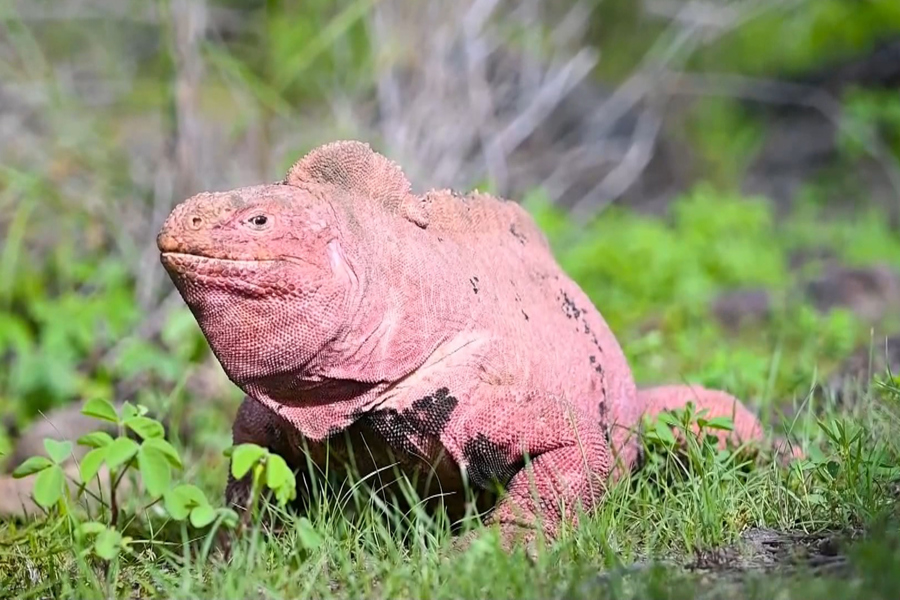
Quito, Jul 19 (EFE).- Two baby pink iguanas (conolophus marthae), a critically endangered and endemic species found only on Ecuador’s Galápagos Islands, have been discovered during a recent scientific expedition to Wolf Volcano on Isabela Island.
The hatchlings, the first confirmed sighting of newborns in years, were located during a monitoring mission by the Galápagos Conservancy and rangers from the Galápagos National Park Directorate (DPNG).
Wolf volcano, known for its remote and rugged terrain, is the only known habitat for the pink iguana species.
“This discovery provides key data on the species’ population dynamics and reinforces the need for sustained research and threat control to ensure long-term survival,” said Christian Sevilla, director of the Galápagos National Park, in a statement released Thursday.
James Gibbs, vice president of Science and Conservation at Galápagos Conservancy, emphasized the broader implications of the discovery.
“This tells us nature is still fighting back. Every hatchling counts,” Gibbs said. “This isn’t just about Galápagos, it’s a global responsibility.”
The find comes as part of the Pink Iguana Conservation and Management Plan (2021-2027), led by DPNG with support from Galápagos Conservancy, Fundación Jocotoco, and Italy’s Tor Vergata University.
Future actions will include increased monitoring using camera traps, studies on species interactions, and strengthening adaptive management strategies.
First discovered in 1986 and formally described in 2009, the pink iguana is limited to the slopes of Wolf Volcano and has an estimated population of fewer than 200 adults.
The Galápagos archipelago, situated about 1,000 kilometers off mainland Ecuador, is renowned for its biodiversity and pristine marine reserves. It also served as a natural laboratory for Charles Darwin’s 19th-century theory of evolution and natural selection. EFE


