


Cassandra Harris
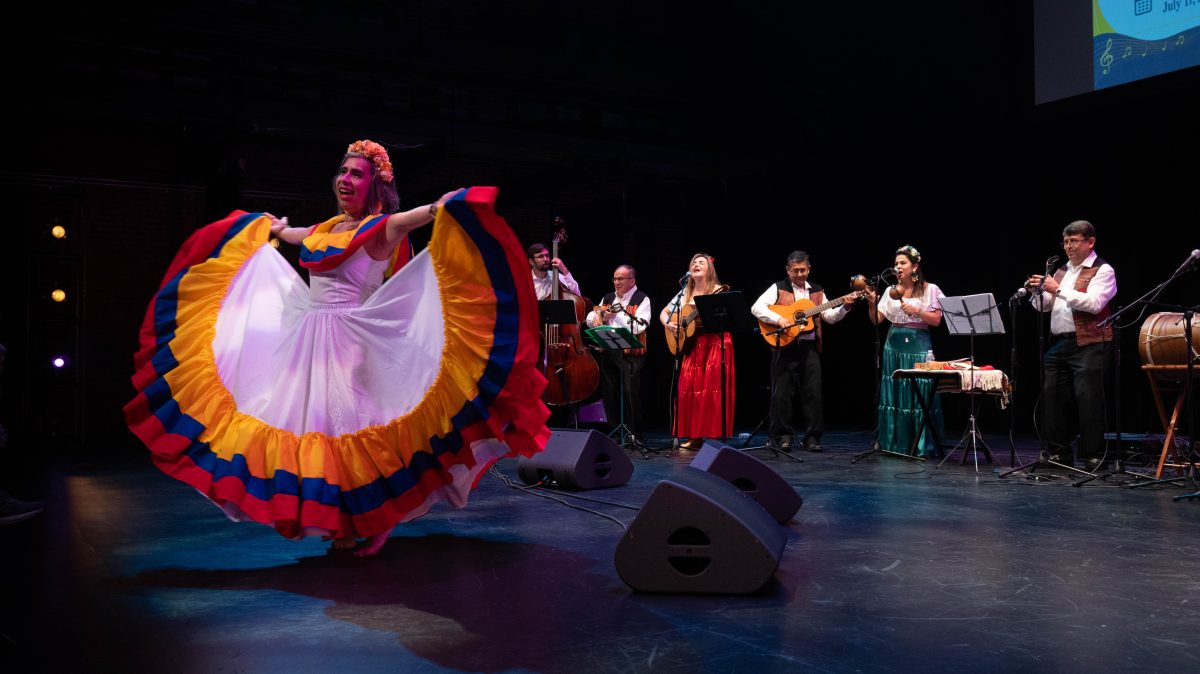
For one night at the New Hazlett Theater, Pittsburgh became a stop along the Andes Mountains. Fiesta de la Tierra brought together two bands separated by thousands of miles and four decades of history — and turned their reunion into a celebration for the whole community.
Tierra Caliente, a folk group from Ibagué, Colombia, hadn’t performed publicly together since the 1980s. Its members met in high school, where they were taught from a young age to sing and play guitar — a tradition woven into daily life in their hometown. They built the group around friendship: two pairs of sisters and Carmen Alicia Martínez, who later moved to the United States and settled in Pittsburgh, splitting the band apart.

The dream of reuniting never went away.
“We finally decided to organize it,” said Music Director Claudia Lucía Contreras. “So we decided to revive the group by coming here, and we’ll likely keep singing and playing more.”
A Reunion Two Months in the Making
It took the five band members in Colombia obtaining the necessary visas — no small task — before the trip could happen. Once it did, the plan came together fast: the New Hazlett performance was booked just two months before it took place.
Bringing Tierra Caliente to Pittsburgh had been Martínez’s dream for years — a chance to unite the band she now plays with in the U.S. with the one she grew up with in Colombia, on a single stage.

That vision is what gave the night its name, and its opening act: Musuhallpa, a Pittsburgh-based Andean group whose name means “Tierra Nueva” in Quechua. Song by song, Musuhallpa guided the audience through the Andes before Tierra Caliente took the stage.
“The program has a beautiful name, ‘Fiesta de la Tierra,’ because it brings together groups representing different lands,” said Musuhallpa Music Director Agustín García, “such as Argentina, Uruguay, Bolivia, Peru, and Mexico — and, above all, it features music from Colombia.”
García is also a luthier, and several of the instruments on stage that night — including an acoustic instrument called the harana — were ones he built himself.

Roots That Go Back to Childhood
For Tierra Caliente, the night carried a deep nostalgia. Growing up in Ibagué, Colombia — often called the country’s Musical City — singing and playing guitar wasn’t optional; it was part of growing up.
“By the time we were older, we all knew how to play and sing,” Contreras said. “We got together because we were close friends — two pairs of sisters plus one friend, Carmen Alicia — for a specific event. We had to sing a few songs together at a theater, and that’s how the group gradually came about.”
A Hometown Connection
In a coincidence that added another layer to the night, Andrés Oliveras, president of Colombia en Pittsburgh and one of the event’s organizers, also grew up in Ibagué. He calls it, fittingly, the Music Capital of Colombia

Watching the crowd the concert brought together meant as much to him as the music itself.
“It wasn’t just Latinos; there were U.S. citizens there too,” Oliveras said. “It’s fantastic to come together and connect through this shared love of art and culture.”

Oliveras noted that the event grew out of a partnership between Colombianos en Pittsburgh and sponsor Barry, of Showcase Motors, who helped make the two-month turnaround possible.
More Than a Concert
For the musicians on stage, Fiesta de la Tierra was proof that decades and distance don’t have to end a shared passion. Whether it was a lifelong friendship rekindled after 40 years or a Pittsburgh Andean group welcoming a Colombian band into its own musical home, the night became something bigger than a performance — a reminder that music can carry a culture across borders, generations, and time.
As Oliveras put it: “Qué rico poder integrarnos y confluir en este amor por el arte y por la cultura.” — How wonderful, to come together in this shared love of art and culture.


3 comments
It was a beautiful show!!!
Yes, it was a fantastic opportunity to celebrate our culture and show our unity as a community. BTW, the name of one of the main sponsor is not Chokas Motors, it’s Showcase Motors. Please make the correction if you can. Thank you!
Thanks for letting us know. We made the correction.